Leave Your Message

Why Choose Concrete Pole Mould for Global Projects?

Choosing the right Concrete Pole Mould can influence project quality, production speed, and long-term infrastructure performance. Across global projects, manufacturers face different pole lengths, wall thicknesses, concrete grades, climates, and transport conditions. A mould must handle these differences without creating unnecessary production delays. Small dimensional errors can affect reinforcement placement, pole alignment, and installation safety. Precision matters.

Experienced producers usually evaluate mould steel quality, structural rigidity, vibration compatibility, release systems, and maintenance requirements. A well-designed mould supports consistent shapes during repeated casting cycles. Smooth internal surfaces can reduce concrete adhesion and simplify demoulding. Reliable suppliers should provide drawings, trial-production records, inspection data, and practical guidance for local conditions. Independent dimensional checks and concrete testing remain essential. No catalogue claim replaces verification.

Global projects also demand careful communication. Engineers should confirm applicable standards, curing methods, lifting points, and shipping limitations before production begins. A mould suitable for humid coastal production may require different protection from one used in a dry inland factory. This is often overlooked. The best choice is not always the cheapest mould or the most automated option. It is the solution that performs steadily under real working conditions, with accessible spare parts and trained operators. Even strong designs can fail when concrete proportions, vibration time, or curing schedules are poorly controlled. That limitation deserves honest attention. By comparing field experience, technical evidence, and total operating costs, project teams can choose a Concrete Pole Mould with greater confidence and fewer surprises.

Why Choose Concrete Pole Mould for Global Projects?

What Is a Concrete Pole Mould?

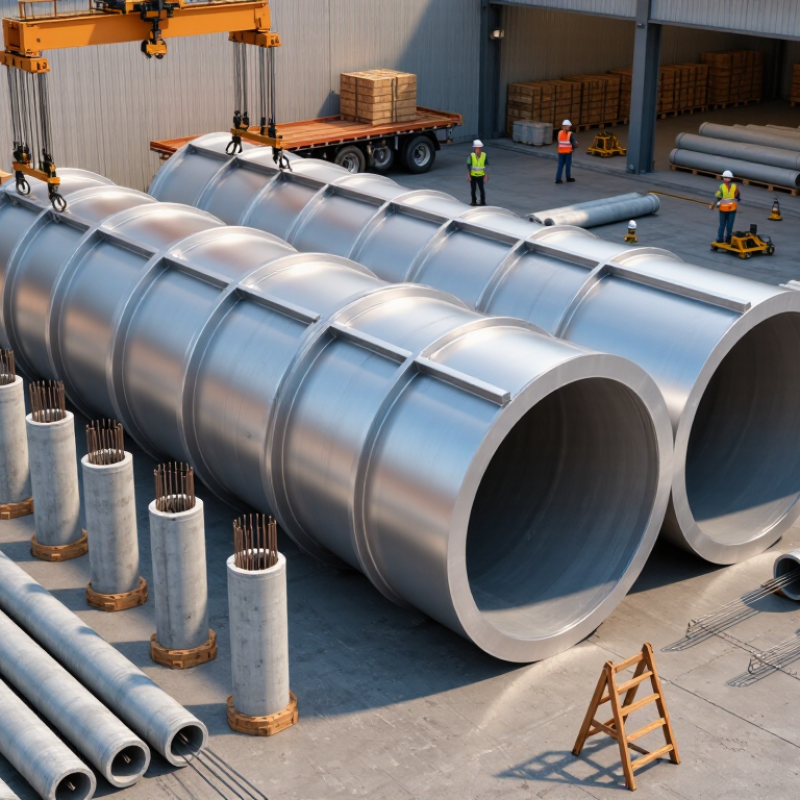
A concrete pole mould is a reusable forming tool that shapes fresh concrete into a controlled pole profile. It usually includes a steel shell, end plates, alignment parts, and secure clamping devices. Some designs support centrifugal casting, while others suit vibration-based production. The chosen mould depends on pole length, diameter, wall thickness, and reinforcement arrangement.

During production, workers place steel reinforcement inside the mould before adding concrete. Vibration or spinning helps reduce air pockets and improve density. A precise mould keeps the pole straight, smooth, and consistent between batches. Small errors can still appear. Uneven clamping, worn edges, or incorrect release-agent application may create marks or dimensional problems.

For international projects, mould design must match local transport limits, utility standards, and installation conditions. Engineers should check drawings, concrete cover, lifting points, and drainage requirements before fabrication. Inspection should include wall thickness, flange position, surface finish, and repeated opening cycles. In practical use, maintenance matters as much as the original design. Cleaning after each pour protects the mould surface. Regular measurement is also necessary, although busy factories sometimes postpone it. That decision can become expensive when several poles repeat the same defect.

Key Advantages of Concrete Pole Moulds

Why Choose Concrete Pole Mould for Global Projects?

Key Advantages of Concrete Pole Moulds

Concrete pole moulds support repeatable production across demanding infrastructure projects. A precise mould controls pole diameter, wall thickness, taper, and connection openings. This consistency helps engineers match approved drawings and simplify site installation. The Global Infrastructure Hub’s Global Infrastructure Outlook estimates that worldwide infrastructure needs may reach 94 trillion dollars by 2040. Standardized production can help contractors manage that scale with fewer avoidable variations.

Consistency matters.

Reusable moulds can reduce material waste and shorten preparation time between casting cycles. They also support prestressed concrete production, which provides strong load performance for utility networks, transport lighting, and communication structures. The International Energy Agency reported in 2023 that annual grid investment must more than double, exceeding 600 billion dollars by 2030. Durable poles and efficient mould systems may reduce maintenance pressure in expanding networks. Local manufacturers can also adapt mould dimensions to regional transport limits and installation equipment.

Concrete is not automatically the best choice. Mould design still requires careful checking for vibration, curing conditions, lifting points, and drainage details. Poor alignment can create hidden stress, even when the finished surface looks smooth. Field experience shows that small defects often become expensive delays. That is why trial casting, dimensional inspection, and documented quality control should remain part of the process, not optional extras.

Concrete Pole Mould Manufacturing and Quality Control

Why Choose Concrete Pole Mould for Global Projects?

Concrete pole mould manufacturing determines more than surface appearance. It influences pole dimensions, reinforcement placement, curing consistency, and transport durability. In a controlled plant, technicians verify mould alignment, steel plate thickness, weld quality, and release-agent coverage before casting. Small errors matter. A two-millimeter offset can affect wall thickness and connection fit.

Quality control should follow documented procedures, not personal judgment alone. Each concrete batch needs checks for slump, aggregate grading, water dosage, and casting temperature. Test specimens should confirm compressive strength under recognized methods, such as ASTM C39. Dimensional inspections also cover length, taper, straightness, lifting points, and socket locations.

The International Energy Agency reported in 2023 that cement production creates about 7% of global carbon dioxide emissions. Accurate moulds can reduce rejected poles, wasted concrete, and repeated transport, although savings depend on production discipline.

Curing deserves close attention. Heat, humidity, and demoulding time can change final performance. In my view, factories sometimes overtrust strength reports while ignoring chipped edges and uneven finishes. That is a mistake. Photographic records, batch traceability, calibration logs, and independent inspections improve reliability across different project locations.

Standards may differ by country, so one mould specification cannot serve every network. Local loading, wind, soil, and utility requirements still need engineering review. Quality is never automatic.

Global Applications and Project Requirements

Why Choose Concrete Pole Mould for Global Projects?

Concrete pole moulds support reliable production across different infrastructure environments. Their repeatable dimensions help manufacturers produce poles for roads, distribution networks, lighting systems, and rural electrification. On international projects, mould selection must match pole length, taper, wall thickness, and reinforcement design. Projects in coastal regions may require stronger durability controls than inland installations. Hot climates also demand careful attention to concrete temperature and curing time. Field teams often check mould alignment before every pour. That simple step prevents uneven surfaces and costly corrections.

Climate changes the production routine. In humid areas, trapped moisture can affect demoulding and surface quality. In cold regions, curing protection becomes more important. Designers should also consider local transport limits, lifting equipment, foundation details, and electrical clearance rules. A mould that works well in one factory may not suit another site. I have seen accurate moulds fail because the workshop lacked proper vibration equipment. Not ideal.

Global project requirements also include clear drawings, traceable material records, and practical inspection procedures. Moulds should allow easy cleaning and safe removal without damaging fresh concrete. Dimensional checks can confirm length, diameter, bolt-hole position, and end-face accuracy. Independent inspections may support compliance with applicable national standards. Digital records improve communication between engineers, suppliers, and site crews. Still, paperwork cannot replace skilled hands. A careful operator may notice a small crack or loose fitting before instruments do.

Why Choose Concrete Pole Mould for Global Projects? - Global Applications and Project Requirements

Project Application Typical Pole Configuration Common Project Requirements Recommended Mould Features Key Selection Data
Distribution Networks
Urban, rural and industrial overhead power lines
Prestressed spun or vibrated concrete poles; commonly approximately 8–15 m long, with tapered circular or polygonal sections Design for conductor loads, wind pressure, equipment weight, foundation conditions and local electrical clearances Rigid steel mould, accurate taper control, smooth internal surface and interchangeable openings for fittings Pole length, top and base dimensions, service load, ultimate load, cable arrangement and required embedment depth
Transmission and Sub-Transmission
Higher-voltage overhead line structures
Longer reinforced or prestressed poles, often used singly, in pairs or as multi-pole structures Higher bending capacity, controlled deflection, increased wind and ice-load resistance where applicable, and strict dimensional tolerances Heavy-duty mould body, reinforced end plates, accurate alignment system and repeatable prestressing or reinforcement positioning Structural loading case, pole slenderness, connection locations, cross-arm geometry and transport limitations
Street Lighting
Roads, bridges, public areas and parking facilities
Tapered concrete poles, typically about 6–12 m long, with a top fitting or luminaire mounting point Controlled verticality, resistance to wind-driven luminaire loads, cable access and compatibility with lighting brackets Precision top insert positioning, removable access-forming components and smooth finish suitable for exposed installations Mounting height, luminaire mass and projected area, wind region, cable-entry position and foundation interface
Telecommunication Networks
Fiber, wireless and combined utility corridors
Small- to medium-section tapered poles, generally selected for communication cables, cabinets and antenna accessories Low vibration, adequate reserve capacity, safe climbing or maintenance provisions and compatibility with shared utility corridors Modular mould sections, accurate embedded-part locations and adaptable holes for brackets, ladders or cable hardware Cable quantity, equipment weight, antenna wind area, attachment elevations and clearance from other services
Railway Electrification
Overhead contact systems and railway signaling
Reinforced or prestressed concrete masts and portal members with carefully positioned mounting inserts Strict geometry, durable performance under vibration, electrical clearance control and resistance to weathering and contamination High-dimensional-accuracy mould, robust insert fixtures, stable closure system and repeatable section alignment Track geometry, contact-wire height, cantilever loads, dynamic effects, corrosion exposure and installation tolerances
Coastal and Marine Infrastructure
Harbors, coastal utilities and waterfront lighting
Dense reinforced or prestressed concrete poles with enhanced durability requirements Low permeability, adequate concrete cover, crack control and resistance to chloride exposure, humidity and strong winds Leak-resistant joints, smooth mould surfaces, accurate cover control and materials suitable for repeated outdoor production Exposure classification, chloride environment, concrete cover, water-cement ratio, curing method and design service life
Wind and Cyclone Regions
Areas exposed to severe storms or tropical weather
High-capacity tapered poles, often prestressed, with reinforced foundations and engineered connections Resistance to high wind moments, debris impact where specified, fatigue effects and serviceability deflection limits High-stiffness mould, secure locking system, precise reinforcement positioning and repeatable production tolerances Basic wind speed, terrain category, gust factor, equipment projected area, pole height and governing load combination
Cold-Climate Projects
Snow, freeze-thaw and seasonal ground movement zones
Reinforced or prestressed poles designed for combined wind, ice and low-temperature exposure Freeze-thaw durability, suitable air entrainment where required, crack control and foundations designed for frost conditions Consistent wall or section thickness, smooth demoulding surface and accurate reinforcement cover control Minimum temperature, ice accretion, freeze-thaw cycles, concrete durability class and frost depth
High-Volume Standardized Production
National utility programs and repeat infrastructure packages
A standardized family of poles with several lengths, load classes and fitting arrangements Consistent quality, short cycle times, low rework rate, traceability and compatibility with automated or semi-automated production Reusable modular moulds, quick-release clamps, replaceable wear parts and inspection points for dimensional control Annual quantity, mould utilization rate, changeover time, maintenance interval and allowable dimensional variation
Export and Remote-Site Projects
Projects with difficult transport or limited local facilities
Pole designs optimized for available transport equipment, local aggregates and site assembly conditions Container or truck loading limits, local material availability, simple maintenance and reliable quality under variable conditions Sectional mould design, corrosion-protected steel, replaceable components and easy inspection without specialized equipment Maximum shipping length, mould weight, local concrete materials, lifting points, storage conditions and installation method
Technical note: The dimensions and requirements shown are typical planning ranges rather than universal design values. Final mould geometry, reinforcement, concrete strength, durability class, load capacity and tolerances should be verified against the project drawings, local building regulations and the applicable national or international standard, such as EN 12843 or ASTM C1089 where adopted by the project authority.

Installation, Maintenance, and Long-Term Cost Factors

Concrete pole moulds influence more than production speed. They shape installation accuracy, worker safety, and long-term maintenance costs. Before casting, technicians should check the mould’s dimensions, joints, locking parts, and internal cleanliness. Even a small alignment error can create uneven wall thickness. That defect may remain hidden until lifting or field installation.

A practical installation routine includes applying a consistent release agent and securing the mould on a level base. Concrete should be placed steadily, with controlled vibration to reduce air pockets. Curing conditions also matter. Sudden drying can cause surface cracks, although this problem is sometimes blamed on the mould unfairly. Experienced teams record temperature, curing time, and batch details. These records make troubleshooting more reliable.

Maintenance is simple, but it must be regular. Clean concrete residue after each cycle, especially around joints and corners. Inspect welds, seals, bolts, and lifting points before the next use. Store moulds under cover, away from standing water and corrosive materials. The cheapest mould is not always the lowest-cost choice. Poor dimensional stability can increase grinding, repairs, rejected poles, labor hours, and project delays. A stronger mould may cost more initially, yet reduce replacement frequency and rework. Still, cost estimates should include transport, cleaning time, spare parts, and downtime. This is where many budgets fail. Local climate and production volume can change the result significantly.

Why Choose Concrete Pole Mould for Global Projects?

Installation, maintenance, and long-term service-life factors compared with common utility-pole materials.

Concrete poles typically provide a long service life with fewer planned maintenance interventions. Their reusable moulds support consistent dimensions and repeatable production, which can improve installation efficiency and reduce long-term maintenance exposure. Values shown are typical engineering planning ranges; actual performance depends on design loads, climate, soil conditions, manufacturing quality, and maintenance practice.